- All
- Product Name
- Product Keyword
- Product Model
- Product Summary
- Product Description
- Multi Field Search
 English
 |


| Quantity: | |
|---|---|
The drying of ginger (usually referring to plants in the ginger family, whose rhizomes are important raw materials for extracting saponins and processing ginger slices) relies on efficient dehydration while preventing the loss and discoloration of active ingredients. Due to the high moisture content, rich starch and saponin content of sliced ginger, surface crust and difficulty in transferring internal moisture are prone to occur during drying.
The current mainstream solution is belt drying, which is suitable for large-scale continuous production.

Working principle of mesh belt dryer
The materials are laid flat on multiple layers of mesh belts, and hot air flows through the material layers from bottom to top or from top to bottom. Multi layer circulation flipping achieves continuous drying, continuous production, high output, uniform and sufficient heat and mass exchange, controllable drying time, multi-layer structure, stepless speed regulation of mesh belts, and heat sources can be steam, natural gas, biomass, air energy, etc. The heat source is isolated from the drying host and does not pollute the materials.
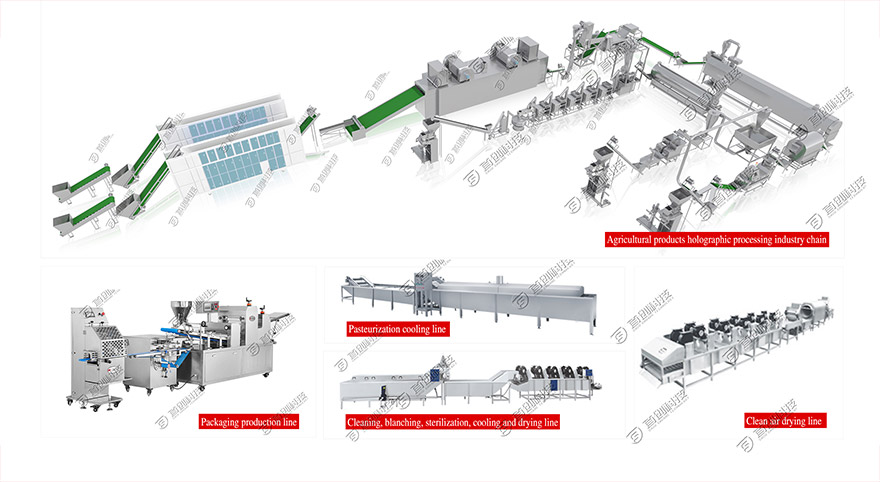
The general process for drying sliced Yellow Ginger is: cleaning → slicing (thickness 3-5mm) → laying mesh → drying → sieving. Uniform slice thickness is the key to ensuring consistent drying.
The drying temperature is usually gradually increased from 55 ℃ to avoid surface crust or saponin decomposition caused by high temperature. Some production lines will also be equipped with cleaning and peeling machines, slicing machines, and crushers, which can be further processed into sugar ginger powder or seasoning ginger powder