- All
- Product Name
- Product Keyword
- Product Model
- Product Summary
- Product Description
- Multi Field Search
 English
 |


| Quantity: | |
|---|---|
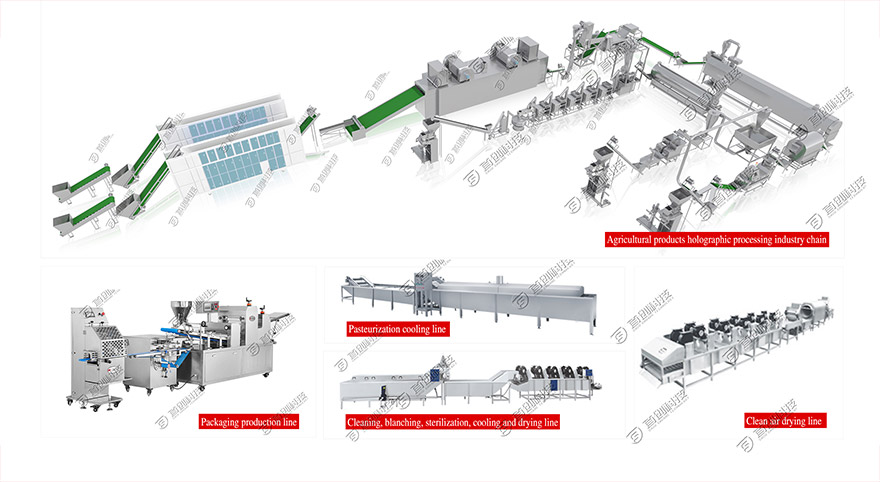
The breadfruit drying production line uses clean hot air as the drying medium, and through precise control of temperature and humidity, gradually migrates the moisture inside the breadfruit to the surface and is carried away. Its implementation usually relies on multi-layer mesh belt dryers or multi temperature zone automated drying rooms.

Pre processing and Fabric Stage
Fresh breadfruit, after being cleaned, sliced, or diced, is evenly and smoothly spread on the stainless steel mesh belt of the dryer using a cloth dispenser. Uniform fabric is the key to ensuring consistency in subsequent drying.
S-shaped dynamic drying path
The mesh belt with pre laid materials is driven into the drying chamber by the transmission device. The interior of the equipment is usually designed as a multi-layer structure, and the mesh belt undergoes reciprocating motion during operation, forming an "S" - shaped walking path.
The beauty of this design lies in the fact that the material will automatically flip and loosen during the process of falling from the upper layer to the lower layer, allowing all surfaces of the material to be fully exposed to the hot air, effectively avoiding drying dead corners caused by accumulation and ensuring uniform drying

Partition precise temperature control, humidity control
Based on the characteristics of breadfruit, such as high starch content and the need to prevent browning, the drying line is usually divided into different temperature zones, such as the early stage dehumidification zone, the mid stage constant speed drying zone, and the late stage slow drying zone.
Each area can independently adjust temperature and humidity. For example, the front section may use a slightly lower temperature for rapid dehumidification to prevent surface hardening and discoloration; In the latter part, suitable temperature is used for internal moisture migration to ensure that the "outside is dry and the inside is also dry".
Efficient and energy-saving hot air system
The clean hot air generated by the heat source (which can be in various forms such as air source heat pump, natural gas, biomass particles, etc.) is sent into the drying room by a fan and forced through the material layer and mesh belt.
Hot air comes into full contact with wet materials, efficiently removing evaporated moisture and achieving rapid drying. Part of the waste heat can be recycled and reused to reduce operating costs.
Intelligent control and discharge
The entire process is intelligently controlled by PLC and touch screen, which can accurately set and automatically adjust the drying curve.
After reaching the set dryness, the material is automatically discharged from the bottom discharge port and enters the next sorting or packaging process.